Understanding your customers deeply is a make-or-break factor for marketing success. With massive amounts of data generated every second, traditional consumer insight methods are no longer sufficient. The rise of AI consumer insights is transforming how mid- and senior-level marketing leaders extract meaningful patterns and actionable information from complex datasets swiftly and accurately. This article dives into how AI-powered tools such as AI consumer insights platforms, social listening AI solutions, and NLP sentiment analysis in marketing are reshaping digital marketing strategies. We will reveal how these technologies enable dynamic AI audience segmentation strategies and utilize data clustering for marketing insights to target and engage consumers like never before.
Let’s explore the essential facets of leveraging AI effectively for consumer insights in digital marketing.
What Are AI Consumer Insights and Why They Matter
AI consumer insights refer to the process of employing artificial intelligence technologies to understand customer behaviors, preferences, and trends. Unlike conventional approaches that rely heavily on manual analysis and historical reports, AI tools can automatically analyze large-scale data sets from diverse channels such as social media, website interactions, transaction histories, and customer feedback.
Why do these insights matter to marketing leaders? Consider these benefits:
- Speed and Scale: AI can process petabytes of data in real-time, unveiling customer intent and sentiment quickly.
- Precision: AI models reduce human biases, providing more objective and granular understanding of consumer patterns.
- Predictive Power: Forecast upcoming trends and customer actions before competitors.
- Personalization: Tailor messaging and experiences based on nuanced audience segments.
Incorporating AI consumer insights platforms into your digital marketing stack is rapidly becoming a competitive imperative.
Key Technologies Driving AI Consumer Insights
Several innovative AI technologies underpin modern consumer insight methods. Understanding these will help you choose the right tools and strategies.
Natural Language Processing (NLP) and Sentiment Analysis
NLP sentiment analysis in marketing allows machines to interpret, categorize, and quantify emotions expressed in text data such as customer reviews, social media posts, and support tickets. This enables real-time monitoring of brand perception and customer satisfaction.
- AI models recognize positive, neutral, and negative sentiments at a granular level.
- Sentiment trends guide responsive content creation and crisis management.
- Combining sentiment with demographic data personalizes outreach effectively.
Social Listening AI Solutions
Modern social listening AI solutions scan social networks and online communities to track brand mentions, competitor activities, and emerging conversations relevant to your niche. Their AI-underpinned analytic capacities provide deep context that manual social listening misses.
- Identification of influencers and advocates.
- Tracking product feedback for iterative improvement.
- Spotting viral trends early for agile marketing response.
Data Clustering and AI Audience Segmentation
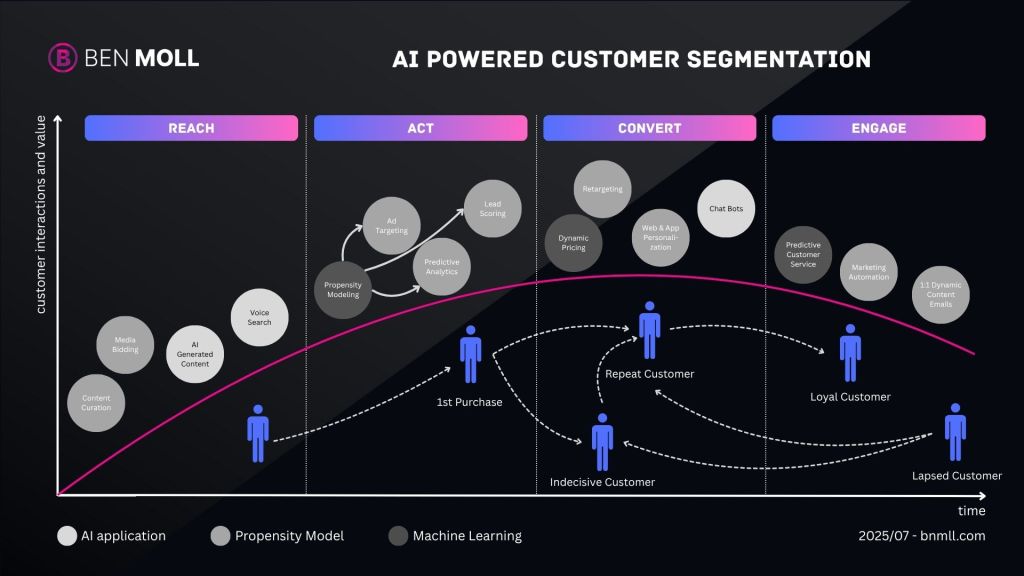
Using data clustering for marketing insights, AI clusters consumers into groups sharing similar characteristics, behaviors, or needs. This foundation supports robust AI audience segmentation strategies that go beyond basic demographics or surface-level criteria.
- Discovery of micro-segments with high conversion potential.
- Adaptation of messaging and offers to specific audience profiles.
- Dynamic updating of segments as consumer behaviors shift.
Implementing AI Consumer Insights Platforms in Your Marketing Strategy
Adoption of AI consumer insights platforms involves integrating AI capabilities into existing marketing processes to enhance decision-making. Here are key steps for seamless implementation:
- Audit your data sources: Identify customer data spread across CRM, ecommerce, social, and email channels.
- Select appropriate AI tools: Choose platforms offering AI-driven segmentation, sentiment analysis, and social listening features relevant to your needs.
- Develop cross-functional teams: Align marketing, analytics, IT, and AI specialists to collaborate effectively.
- Train marketing staff: Educate teams on AI insights interpretation and execution.
- Iterate and optimize: Use AI insights feedback loop to continuously refine audience profiles and campaigns.
Successful implementation maximizes precision targeting and optimization of marketing spend.
Case Studies: AI Consumer Insights in Action
Real-world examples illustrate the transformative impact of AI consumer insights.
Example 1: A Global Retailer’s Use of NLP Sentiment Analysis
A multinational retail brand deployed NLP sentiment analysis across social channels and product reviews to gauge response to a new product line. The insights revealed unexpected regional sentiment differences, allowing the company to localize messaging and increase sales by 18% in under six months.
Example 2: Finance Sector Leveraging AI Audience Segmentation
A major financial institution used AI-powered data clustering to identify new customer segments interested in sustainable investment products. This facilitated personalized campaign delivery, increasing lead conversion rates by 25% and customer retention significantly.
Challenges and Best Practices When Using AI for Consumer Insights
Marketers should be mindful of common challenges while leveraging AI consumer insights:
- Data Privacy and Compliance: Ensure AI platforms comply with GDPR and other regulations.
- Data Quality: Poor data input leads to faulty insights; invest in data cleansing.
- Overreliance on AI: Balance human intuition with AI analytics.
- Bias Mitigation: AI models must be monitored to avoid perpetuating biases.
Best practices include continuous training, integrating human expertise in interpretation, and maintaining transparent AI governance frameworks.
The Future of AI Consumer Insights in Digital Marketing
The evolution of AI promises even more sophisticated consumer insight capabilities such as multimodal data analysis (combining text, video, voice). Emerging AI models will offer hyper-personalization and predictive analytics at unprecedented scales.
Marketing leaders who harness AI consumer insights effectively will lead their industries by delivering highly resonant campaigns, optimizing customer experiences, and driving higher revenue.
External resources for further insights include:
– Harvard Business Review: How AI is Changing How Customers Shop
– Gartner: AI Insights and Trends
Infographic and Chart Proposal
- Infographic idea: “The Anatomy of AI Consumer Insights” — Visually breaking down AI technologies (NLP, clustering, social listening) with examples of marketing use cases and business outcomes.
- Chart idea: “Impact of AI Consumer Insights on Marketing KPIs” — Displaying percentage improvements in lead conversion, engagement rate, ROI, and customer retention before and after AI adoption.
Summary: Top 5 Takeaways
- AI consumer insights enable faster, more precise understanding of customer behaviors and sentiments.
- Technologies like NLP sentiment analysis and social listening AI solutions provide rich contextual data.
- AI audience segmentation strategies through data clustering uncover valuable micro-segments for targeted marketing.
- Successful implementation requires quality data, cross-team collaboration, and ongoing optimization.
- Future AI advancements will further enhance personalization and predictive marketing capabilities.